- December 15 2025
- | Truck Accidents
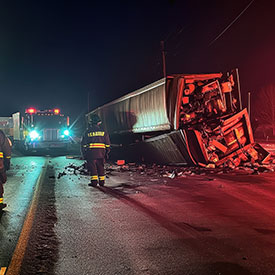
A collision with a commercial truck is fundamentally different from a standard car crash. In Nevada, these incidents trigger a dual layer of governance (state traffic laws and federal regulations) and typically involve a legal doctrine called vicarious liability. This means you are typically taking on a corporation, not just a driver.
Furthermore, there are aspects of these cases that you simply cannot handle on your own. They demand rapid preservation of logbooks, electronic control module data, and maintenance records, as well as aggressive dealings with multiple commercial insurers and defense teams.
An experienced Nevada truck accident lawyer levels that playing field by identifying every liable party, building a damages case that reflects the full impact of your injuries, and pushing for the maximum compensation available under state and federal law.
Our practice at Leverty & Associates focuses on doing exactly that. If you have questions about a recent collision involving a commercial vehicle, call us.
Key Takeaways for Nevada Truck Accident Cases
- Federal regulations determine fault in many truck accidents. This means a lawyer must investigate compliance with rules like Hours of Service, not just state traffic laws.
- You are typically suing a corporation, not just the driver. The legal doctrine of vicarious liability holds the trucking company responsible for its driver’s negligence.
- Evidence disappears quickly and legally without swift action. A formal preservation letter is required to stop trucking companies from destroying crucial records like driver logs and black box data.
The Dual Regulatory Framework: Where Federal and State Laws Collide
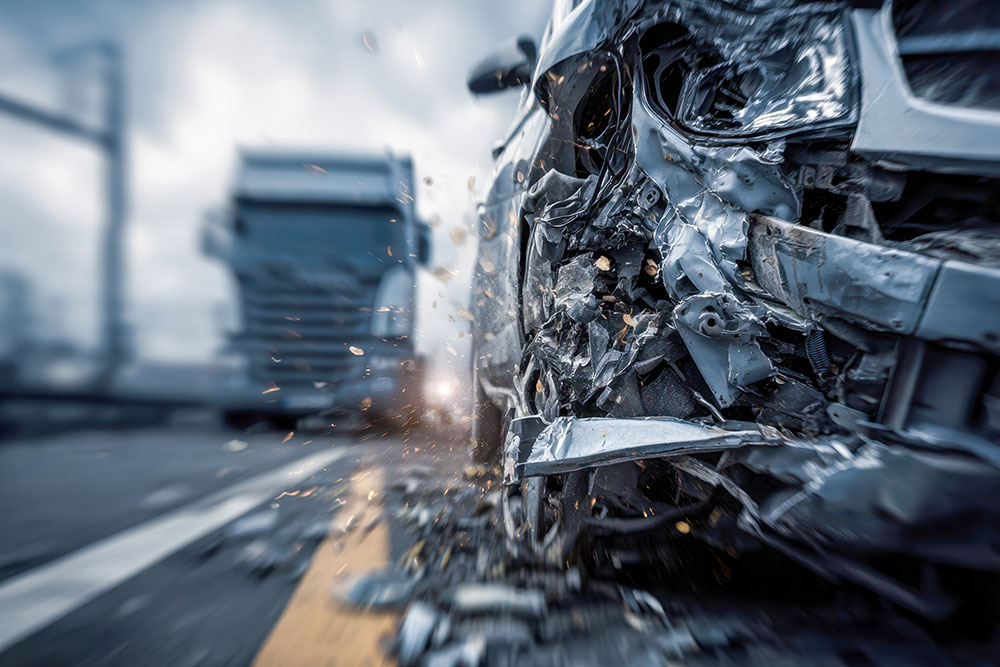
Most drivers reasonably assume that Nevada’s state traffic laws are the only rules that matter after a crash. In a typical car accident, that is largely true. However, when an 80,000-pound commercial truck is involved, the real battlefield for establishing fault shifts to federal compliance.
Interstate trucking carriers must adhere to stringent regulations set by the Federal Motor Carrier Safety Administration (FMCSA). A key area of focus is the Hours of Service (HOS) rules, which dictate how long a driver operates a vehicle without rest. For property-carrying vehicles, this includes an 11-hour driving limit within a 14-hour duty window, followed by a mandatory 10 consecutive hours off-duty.
Determining whether federal interstate rules or Nevada’s intrastate regulations apply significantly alters a case. If a driver violated HOS limits to meet a delivery deadline, that violation is strong evidence of negligence. Uncovering these violations requires a detailed analysis of driver logs, dispatch records, and other data—a task that falls far outside the scope of a standard insurance claim.
Vicarious Liability and Piercing the Corporate Veil
In a standard car wreck, you pursue a claim against the at-fault driver. In a commercial truck wreck, the driver is usually just the starting point; the real liability frequently lies with their employer.
This is thanks to a legal principle known as respondeat superior, also known as vicarious liability. Put simply, an employer can be held responsible for the negligent actions of an employee performing their job duties.
Trucking companies are multi-billion dollar companies with armies of lawyers on hand whose only purpose is to protect their corporate interests. They are well-versed with every nuance of the law. You need someone in your corner advocating just as aggressively to protect your interests.
The Race Against Spoliation: Preserving Digital and Physical Evidence
Large trucking companies have Rapid Response Teams (investigators and attorneys) sent to an accident scene to manage their risk and control the narrative from the very beginning. You need a counter-force working to protect your interests with the same urgency.
Evidence in these cases is fragile and fleeting. Without a formal legal demand to preserve it, trucking companies legally destroy records. This is known as the spoliation of evidence. Driver logs, inspection reports, and dispatch communications may be discarded after a set period, sometimes as short as six months.
A crucial piece of evidence is the truck’s black box, or Event Data Recorder (EDR). This device captures data points like speed, braking, and throttle usage in the moments just before impact. This information, along with data from Electronic Logging Devices (ELDs), is invaluable in reconstructing the accident and proving fault. This evidence is typically impossible to obtain on your own. Once you retain us, we send immediate spoliation letters to freeze all potential evidence, from dashcam footage to maintenance files.
Calculating Damages in Catastrophic Injury Cases
The immense size and weight of a commercial truck mean that injuries are rarely minor. The medical costs associated with treating conditions like traumatic brain injuries (TBI) or spinal cord damage quickly exhaust the limits of a standard auto insurance policy.
While trucking companies are required by federal law to carry significant insurance policies, which typically start at $750,000, their insurers fight aggressively to protect those high-dollar limits. An initial settlement offer will almost never account for the full scope of your future needs.
Properly calculating damages may involve developing a comprehensive Life Care Plan to account for future medical treatments, assistive devices, and in-home care. If you are unable to return to your previous job, we work with vocational rehabilitation experts to determine the full extent of your lost earning capacity.
Trying to account for all damages on your own while you’re hurting is basically impossible. With our help, we will track down every dollar you may be entitled to.
Dealing With Nevada’s Comparative Negligence in Trucking Disputes

The trucking company’s defense attorneys have one primary goal: to shift as much blame as possible onto you. Under Nevada’s modified comparative negligence rule, this strategy has devastating consequences. According to NRS 41.141, if you are found 51% or more at fault for the accident, you are barred from recovering any compensation.
Defense lawyers are skilled at using arguments designed to place blame on the passenger vehicle. They might claim you were driving in the truck’s no-zone or blind spot, or that you made an unsafe lane change. We counter these tactics by employing accident reconstructionists who use physical and digital evidence to demonstrate how the truck driver’s actions were the primary cause of the collision.
Frequently Asked Questions for Nevada Truck Accident Claims
Yes, in some cases. If improper or unbalanced loading of cargo contributed to the truck losing control, the shipping company or cargo loader could be held liable.
Generally, the statute of limitations for personal injury claims in Nevada is two years from the date of the accident. However, the need to preserve evidence makes it critical to take action much sooner.
This is common in trucking cases. It may mean the case could be handled in federal court under what is known as diversity jurisdiction. We’re prepared to manage the procedural requirements of interstate litigation.
Yes. Federal and state laws mandate significantly higher minimum insurance coverage for commercial carriers due to the catastrophic damage their vehicles cause. General freight carriers must have at least $750,000 in liability coverage.
We advise declining early offers. These offers are typically made before the full extent of your injuries and long-term medical needs are known and are designed to limit the company’s financial exposure.
Do Not Face Corporate Defense Teams Alone
The power dynamic between an injured individual and a commercial transportation company is vast, but it is not insurmountable. You are not expected to become an expert in federal transportation code overnight to pursue justice.
You simply need legal counsel that already has that knowledge. We are ready to secure the evidence and build your case today.
Call Leverty & Associates now for a free, no-obligation review of your options.
 With his master’s in insurance law, Patrick routinely helps individuals and businesses who are having issues with their insurance company. He also has extensive experience with personal injury actions, complex tort actions, product liability matters, and class actions. Patrick Leverty is rated AV by Martindale Hubbell (the highest rating) and has been granted membership in the Million Dollar Advocate Forum, and Multi-Million Dollar Advocate Forum. Patrick Leverty has been certified as a Personal Injury Specialist by the State Bar of Nevada. [